Session 1 A: From classical to integrated remote sensing. New observation strategies for clouds and precipitation (multi-frequency, spectral polarimetry, multi-sensor)
- Estimating precipitation charcteristics using disdrometer and RADAR observations
Antonoglou, Nikolaos (Deutscher Wetterdienst), Abstract ID 74
- Country-wide analysis of CML rainfall estimation in Zambia: Strengths, weaknesses and the way forward
Chwala, Christian (KIT (IMK-IFU)), Abstract ID 104
- Multi-frequency radar observations of mountainous precipitation during the CHOPIN campaign
Clerx, Nicole (Environmental Remote Sensing Laboratory, EPFL), Abstract ID 110
- Ice particle characterisation with the VISSS: insights from field campaigns and statistical analysis
Ettrichrätz, Veronika (Leipzig Institute for Meteorology (LIM), Leipzig University), Abstract ID 109
- Retrieval of the maximum diameter from 2DVD observations and their synergy with remote sensing measurements
Gaudek, Tom (TROPOS), Abstract ID 50
- GPM-API: A Python Interface to Access the Global Precipitation Measurement Mission Satellites Data Archive
Ghiggi, Gionata (EPFL), Abstract ID 56
- IcePolCKa - A Review
Köcher, Gregor (Meteorologisches Institut, Ludwig-Maximilians-Universität München), Abstract ID 126
- Flux Observations for Process-Informed Quantitative Precipitation Estimates
Matland-Dixon, Aimee (The University of Oklahoma), Abstract ID 142
- Evaluation of Traditional and Innovative Methods for Reflectivity Calibration in Meteorological Radar
Myagkov, Alexander (Radiometer Physics GmbH), Abstract ID 97
- Enhanced composition of X- and C-band radar data
Oude Nijhuis, Albert (SkyEcho B.V.), Abstract ID 92
- Do crowdsourced data improve rainfall observations at the catchment scale? A Europe-wide assessment
Rombeek, Nathalie (Delft University of Technology), Abstract ID 120
- The Vertical Distribution of Particle Shape (VDPS) Method: Introduction, Application and Evaluation
Teisseire, Audrey (TROPOS), Abstract ID 144
Session 1 B: From classical to integrated remote sensing. New retrieval and estimation techniques (e.g. fusion, Bayesian)
- Addressing QPE Limitations with Solid State Transmitter X-Band Radar
Chaves González, Nicolás Andrés (Politecnico di Milano), Abstract ID 77
- Maximum-Likelihood and Hamiltonian Monte Carlo Techniques to Doppler Moment Estimation for Precipitation using Weather Radar Echoes
Dash, Tworit (Delft University of Technology), Abstract ID 116
- The GPM-GEO Archive: A Multimodal Remote Sensing Dataset for Cloud and Precipitation Research
Ghiggi, Gionata (EPFL), Abstract ID 57
- Data-driven classification of polarised weather radar observations
Lukach, Maryna (Royal Meteorological Institute of Belgium (RMI), National Centre for Atmospheric Science (NCAS), University of Leeds), Abstract ID 40
- Non-parametric Estimation of Drop-Size Distribution Profiles Using Cloud Radar Spectral Polarimetry
Nomokonova, Tatiana (RPG Radiometer Physics GmbH), Abstract ID 100
Session 2 A: Modeling and parameterization. New observations for modeling and parameterization development
Session 2 B: Modeling and parameterization. Model parameter estimation
Session 3 A: Modeling and nowcasting. Modeling elements in nowcasting
Session 4 A: Data assimilation. Data assimilation integrating nowcasting and new observations
Session 4 B: Data assimilation. Blending and probabilistic techniques based on nowcasting and NWP ensembles
Session 5 A: Floods and extremes. Extreme precipitation events
- Real-time assessment of rainfall extremity using observations and seamless short-term forecasts in small river catchments in Germany
Bondy, Jan (Deutscher Wetterdienst), Abstract ID 95
- Automatic Early warning for severe thunderstorms in Piemonte, Italy
Cremonini, Roberto (Arpa Piemonte), Abstract ID 136
- Precipitation and hydrological events in Northwest Bulgaria since 2001
Popov, Hristo (Sofia University), Abstract ID 102
- Tailoring Weather Warnings in the DWD Warning Portal to Meet the Requirements of Flood Forecasting Centers
Rüth, Maja (Deutscher Wetterdienst), Abstract ID 96
Session 5 B: Floods and extremes. Evaluation, verification and interfaces
- Predictability plots as a means to assess meteorological input for hydrological models
Blumenstein-Weingartz, Ina (Deutscher Wetterdienst), Abstract ID 139
- Rain, Snow or Freezing Rain? – Radar-based Surface Precipitation Type Analysis and Verification at DWD
Schultze, Markus (Deutscher Wetterdienst), Abstract ID 101
- QPE, QPF and EPS in flood forecasting
Heppelmann, Tobias (State Environmental Agency Rhineland-Palatinate), Abstract ID 94
- Predicting inflows to the Soyang River Dam using Weather climate data and Machine learning
Kim, Byung Sik (Department of Artificial Intelligence & Software/Graduate School of Disaster Prevention, Kangwon National University), Abstract ID 70
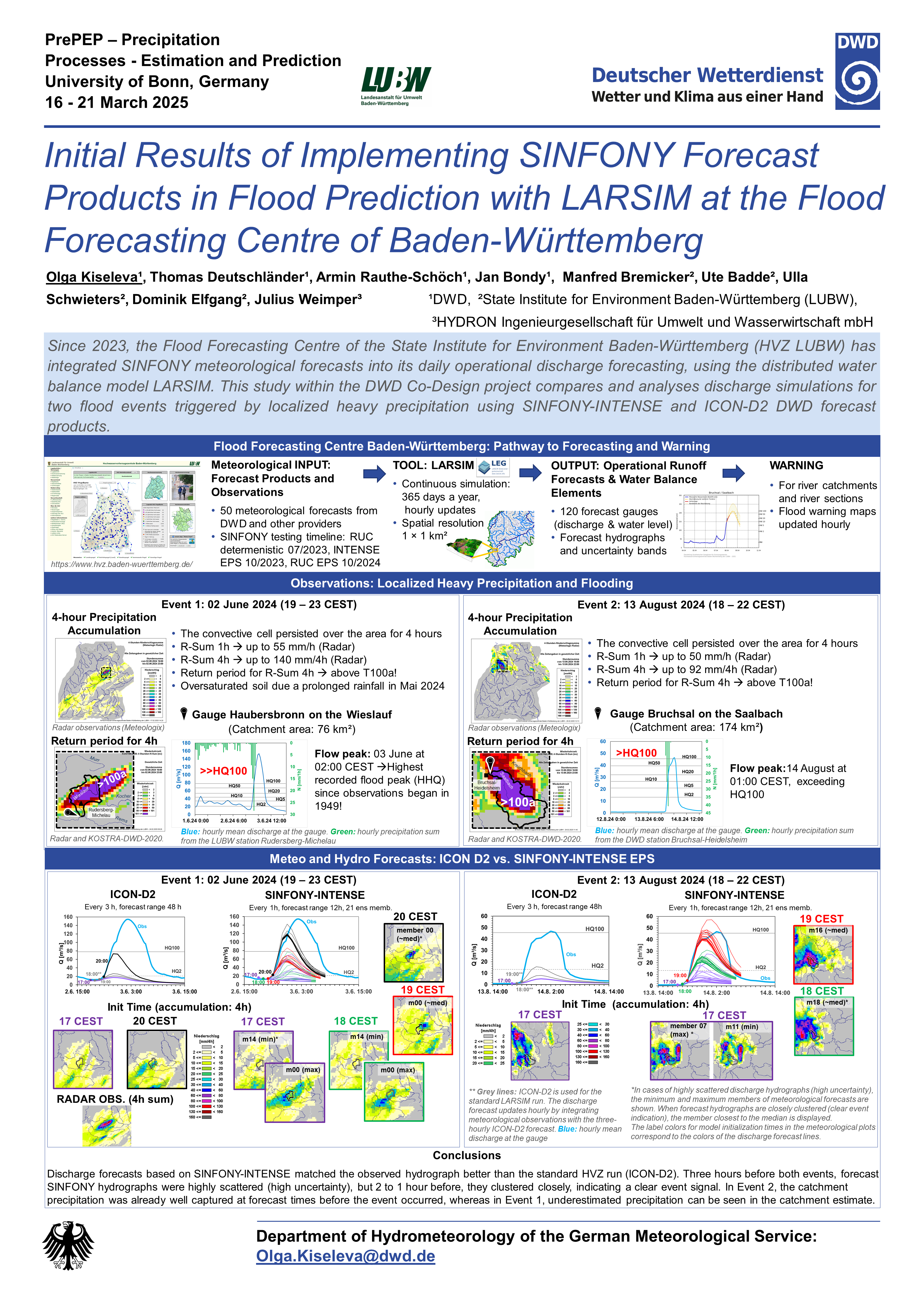
- Initial Results of Implementing SINFONY Forecast Products in Flood Prediction Using the LARSIM Model at the Flood Forecast Centre of Baden-Württemberg
Kiseleva, Olga (Deutscher Wetterdienst), Abstract ID 39
- Predicting hydrological drought in Gangwon the Far East using weather climate data and AI models
Park, Ji Hun (AI for Climate & Disaster Management Center, Kangwon National University), Abstract ID 69
- Improving Flood Forecasting by Assimilating Remotely Sensed Soil Moisture Data into the ParFlow-CLM Model
Soltani, Samira Sadat (Institute of Bio- and Geosciences; Agrosphere (IBG 3), Forschungszentrum Jülich GmbH), Abstract ID 20